Pay Transparency & Reports
Reporting that holds up, straight from your live data.
Build directive aligned pay gap reports from the same numbers behind your analysis, your alerts and your employee answers. Worker groups come from your job architecture, and the unexplained gap comes from a real regression model.
45 minutes. See a report built from your own structure.
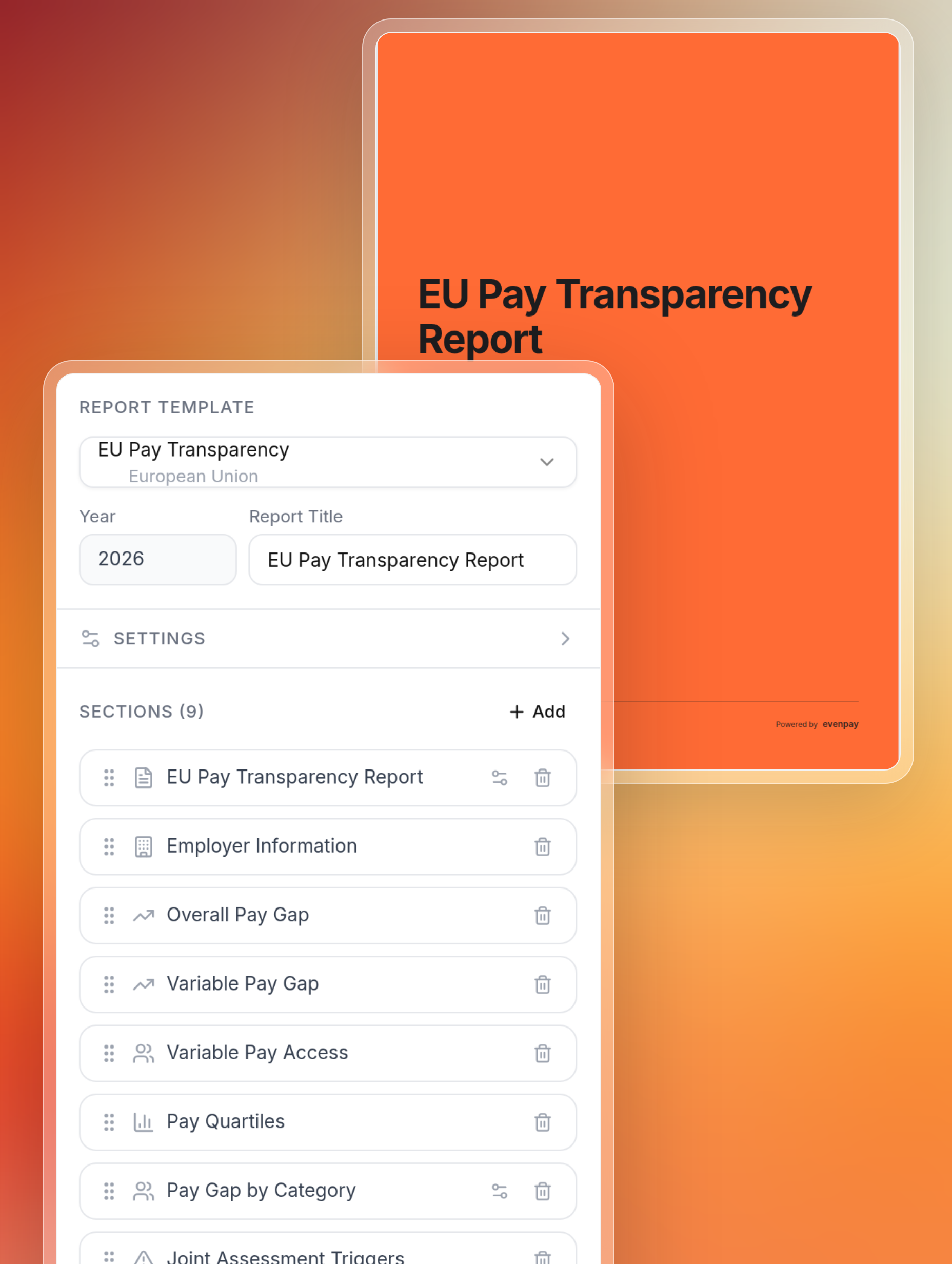
Every section the directive expects, generated not assembled.
Directive aligned reports, section by section
Employer information, the overall mean and median gender pay gap, the adjusted gap, the gap in variable and complementary pay and the share of each gender receiving it, worker group breakdowns by gender, quartile distribution and gender distribution by level. Add your own text blocks and switch sections on or off.
- Mean and median gap alongside the adjusted, unexplained gap
- Variable pay gap and access, worker groups, quartiles and gender distribution by level
- Your branding, your commentary, your choice of sections
Categories of workers, formed the way the directive expects
Groups are derived from your job architecture: job family at each job level, or by level, family or position alone, using the same Equal Value of Work framework as your analysis and your employee responses. There is no second definition to keep in sync.
- Groups built from job family and level, or from level, family or position alone
- One equal value definition across analysis, alerts and reporting
- No parallel spreadsheet to maintain
Gaps above five percent get flagged automatically
Where a worker group shows an unjustified gap of five percent or more, the directive's threshold for a joint pay assessment, Evenpay flags it without anyone running a report. From the alert you can open a joint pay assessment case, add employee representatives as participants and document the analysis and the corrective actions in the same place.
- Automatic detection at the five percent threshold
- See which groups need attention, and what drives the gap
- Joint pay assessment cases opened straight from the alert
Watch the gap move, not just its snapshot
Year over year gap trends and monthly charts show whether your actions are working. Filter across dimensions together, for example one level in one department in one country.
- Year over year and monthly trend charts
- Filter level, department and country in combination
- Templates for the EU standard and public reports, Finland, Sweden and CSRD social metrics
The assessment the directive asks for, run inside the product.
When a gap crosses five percent, the assessment starts here
Article 10 asks for a joint pay assessment with employee representatives when a category of workers shows an unjustified gap of at least five percent that is not remedied within six months. In Evenpay a group alert becomes an assessment case in one step: add the representatives as participants, record the analysis of causes and the pay components reviewed, assign corrective actions with an owner, and keep the whole record audit logged. The assessment triggers also appear as a section in the regulatory report.
- Open a joint pay assessment case straight from a group alert
- Participants, analysis and corrective actions in one audit logged record
- Joint assessment triggers listed as a section of the report itself
From raw data to a report you can defend
The numbers in the report are the numbers in the product. Nothing is retyped.
Connect your data
Import from your HR system, payroll or a file, on a schedule you set.
Groups form from your architecture
Job families, levels and positions become the categories of workers.
The model separates the gap
Regression splits what objective factors explain from what remains unexplained.
Generate and brand the report
Add commentary, choose sections, and export when you need it.
Common questions about pay gap reporting
Reporting is the output, not the starting point
Job Architecture
Worker groups and the equal value framework the report depends on.
Intelligence
The regression engine behind the adjusted gap, with its statistics on show.
Pay Gap Alerts & Anomalies
Find out about a gap through monitoring rather than at reporting time.
Pay Gap Justifications
Documented, objective reasons that reduce the unexplained figure you report.