Salary Recommendations
Objective, data-backed guidance for every salary decision.
Evenpay calculates ideal salaries using your organization’s real pay factors — giving managers and HR a clear view of who is fairly compensated, underpaid, or overpaid.
No credit card required • 14-day free trial
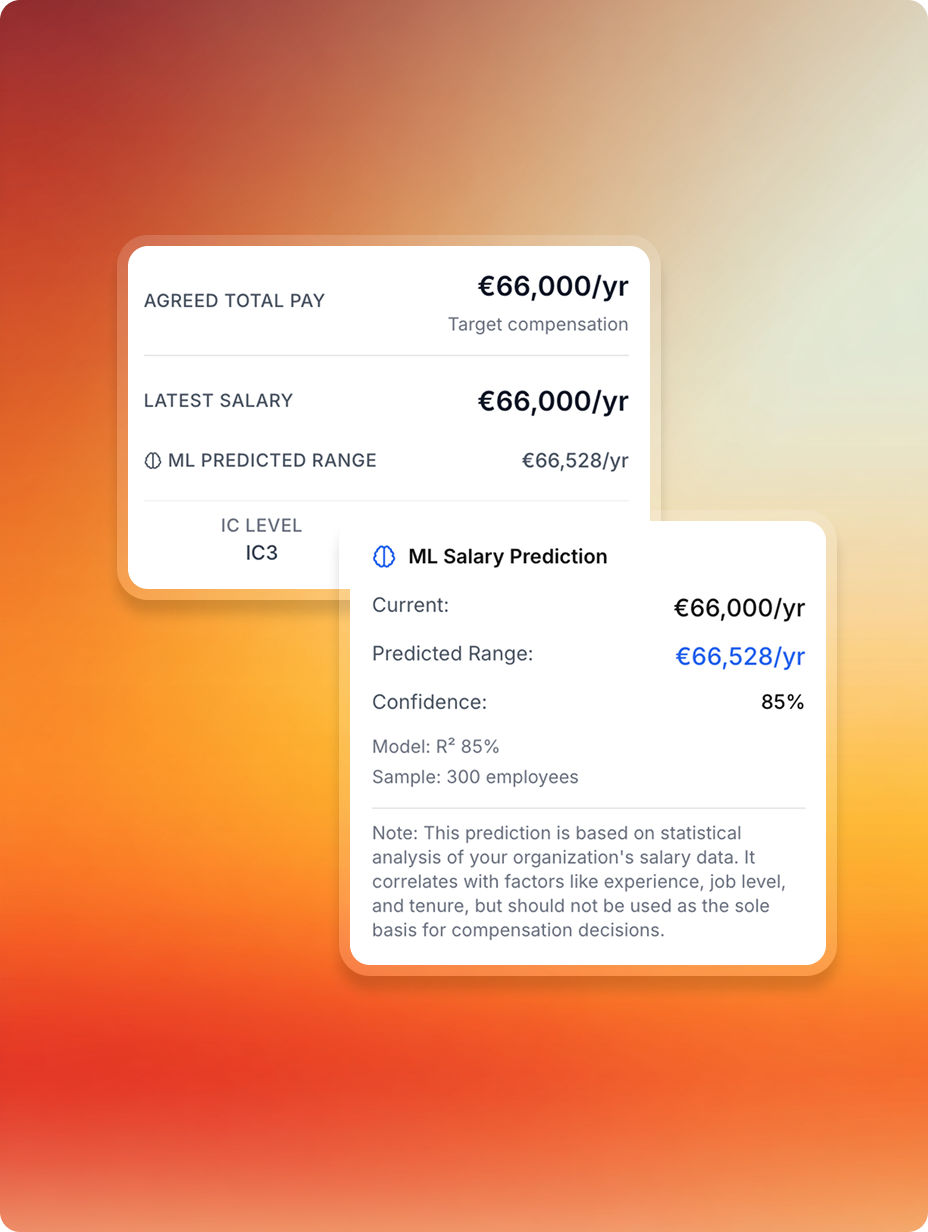
Know what’s fair
Objective, Model-Based Salary Estimates
Recommendations are generated using your organization’s own pay logic, analyzed through ML-based algorithms.
Spot Under- and Over-Compensation Instantly
Quickly see who is above or below where they should be, based on performance, competence, experience, and other pay factors.
A Reliable Starting Point for Salary Reviews
Managers begin reviews with unbiased, data-driven recommendations rather than personal judgment or guesswork.
Fair, transparent salary decisions — without opinions or guesswork
Mathematically ideal compensation
Compensation decisions can easily become subjective, political, or inconsistent across teams. Evenpay solves this by calculating an ideal salary for every employee based on how your organization actually values experience, competence, performance, responsibilities, education, and other objective factors. Using the same ML-algorithms that powers your pay-gap reporting, the system identifies exactly where each employee should sit relative to peers.
This gives HR and managers a crystal-clear view of under- or over-compensation. Instead of vague feelings or historical habits, they see a mathematically grounded benchmark that reflects the company’s own pay structure — not market estimates or external opinions.
Salary recommendations become the natural starting point for any compensation review. Managers can compare their team’s pay positioning against the organization-wide model, understand the rationale, and decide how to close gaps or justify differences. It reduces friction, eliminates bias, and ensures consistent decisions across departments.
Because recommendations are generated from your internal data — not generic formulas — they adapt as your workforce evolves. Promotions, new skill levels, changing role demands, and updated performance outcomes all feed into the model, keeping recommendations accurate and aligned with real contribution.
Over time, leaders gain a clearer understanding of how fairly their organization compensates people, where structural issues may exist, and which roles or units require attention. It is one of the simplest and most reliable ways to bring fairness, transparency, and discipline into compensation.
Ready to achieve pay equity?
Join thousands of companies creating fairer workplaces with data-driven compensation insights.